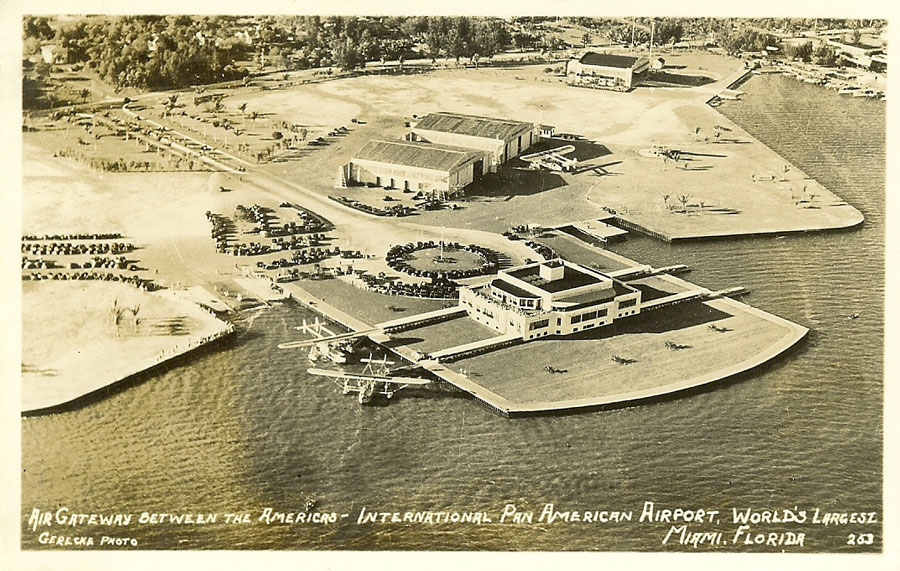
In 1956, Miami had been a city for just 60 years.
In the years since its founding in 1896, the town had grown from a small settlement on the banks of the Miami River with a population of a thousand, to a bustling mid-sized city of a quarter-million.
On the surface, 1950's Miami appeared to be small-town friendly. Day-to-day life was simple, uncomplicated.
Former Florida governor and U.S. senator Bob Graham, a 19 year-old college freshman in 1956, remembers the time fondly: "There wasn't a better time and place to grow up. Miami was a relatively small and neighborly place; quiet and laid back."
South Florida's two or three television stations signed off shortly after midnight. Radio station playlists included songs by World War II era singers like Frank Sinatra, Perry Como, Dean Martin and Kay Starr.
Downtown Miami was the city's business, entertainment and cultural hub. Plans for large suburban shopping centers with multi-screen theaters were still on the drawing boards. The influx of Cuban refugees would not occur for another five years.
My-am-uh - as many locals called it - was as Southern, conservative and deeply religious as any comparably sized town in Alabama, Georgia or Mississippi.
The city's afternoon newspaper, the Miami Daily News, printed a Bible verse daily on its editorial page. On Saturdays the Miami Herald carried two pages of church news.
But for those who cared to look, an undercurrent of unfairness was visible just below Miami's placid facade.
White males dominated the city's political power structure, businesses and newspapers and the word "change" was not in their vocabulary. They made the rules and inequality was the rule of the day. Blacks were barred from restaurants, theaters and beaches frequented by whites. Miami's schools - like the rest of the South - were also segregated.
"Before Elvis, there was nothing." -John Lennon
In August 1956, a lavender Lincoln Premiere speeding south on US1 was bringing change to Miami - whether it wanted it or not. One of the car's occupants was a 21 year-old Memphis truck driver-turned-singer named Elvis Presley.
Presley was no post-war balladeer. He sang "rock 'n roll"... a new kind of music that took its name from a euphemism for raunchy sex - as in "my baby loves to rock 'n roll all night long."
"This boy had everything. He had the looks, the moves, the manager, and the talent. And he didn’t look like Mr. Ed like a lot of the rest of us did. In the way he looked, way he talked, way he acted - he really was different." -Carl Perkins
Exactly three years earlier, in August 1953, Presley walked into Sun Records in Memphis with either a $7.75 or $12 guitar - depending on which story you believe - and paid for a few minutes of studio time.
Sun's owner, Sam Phillips, who had been on the look-out for a white singer with a "Negro sound," liked what he heard and soon invited Presley back for another session.
A recording contract followed.
"Elvis Aaron Presley, [is] a drape-suited, tight-trousered young man of 21, and the sight and sound of him drive teenage girls wild. All through the South and West, Elvis is packing theaters, fighting off shrieking admirers, disturbing parents, puckering the brows of psychologists, and filling letters-to-the-editor columns with cries of alarm and from adolescents, counter-cries of adulation." -TIME magazine. May, 1956
In 1956, Presley's popularity with teens and young adults exploded after almost two years of live concerts throughout the South. And by the summer of '56 a succession of national television appearances not only boosted his record sales among teens but also caused a stir as Eisenhower's middle America got a look at his on-stage gyrations and an earful of his style of "rock 'n roll" music.
With the filming of his first movie set to start in late August, Presley's days as a live performer were numbered. His manager, Col. Tom Parker, had scheduled one more series of live concerts in seven Florida cities.
"Without preamble, the three-piece band cuts loose. In the spotlight, the lanky singer flails furious rhythms on his guitar, every now and then breaking a string. In a pivoting stance, his hips swing sensuously from side to side and his entire body takes on a frantic quiver, as if he had swallowed a jackhammer." -TIME magazine, May, 1956
The tour's first stop was Miami, where Presley and his three back-up musicians had been booked for seven shows on Aug. 3rd and 4th at the ornate Olympia Theater on Flagler Street.
It was perhaps fitting that Presley's last tour would include a visit to Miami.
In April, his haunting and eerie single, "Heartbreak Hotel," hit number one on the pop charts. The song's composers, Mae Axton and Tommy Durden, were inspired by a 1955 Miami Herald article about a man who had committed suicide in a downtown Miami hotel leaving only a one-line farewell note that read, "I walk a lonely street."
Shortly after midnight on Friday, Aug. 3, as Presley rolled into Miami in his Lincoln, frenzied fans were already beginning to gather outside the Olympia.
Presley checked into the downtown Robert Clay Hotel, a few blocks from the theater; his first show scheduled for 3:30 Friday afternoon,
"[Presley is] the virtuoso of hootchy-kootchy." -The New York Times
But even before his arrival, some in town had worked themselves into a different kind of frenzy over his visit.
Herb Rau, the Miami Daily News show biz columnist wrote on August 1st, "So that the Olympia theater won't be the scene of a two day riot, the management's taking every precaution to guard Elvis Presley against teen-age trouble this weekend. Every delinquent kid in town - plus many who aren't delinquents but are fascinated by a duck-tailed hair-do playing the guitar and squirming his hips - will be on hand Friday and Saturday." Rau went on to say the theater had hired a dozen off-duty cops to keep order.
Rau also reported that Col. Parker had turned down an invitation for Presley to stay at the swanky Fontainebleau Hotel in Miami Beach because he feared hordes of fans might damage the place. Parker also nixed any other Miami appearances for Presley. According to Rau: "he's afraid to take him outside the theater because the kids would tear him apart."
"It isn’t enough to say that Elvis is kind to his parents, sends money home, and is the same unspoiled kid he was before all the commotion began. That still isn’t a free ticket to behave like a sex maniac in public." -Cosmopolitan magazine, Dec., 1956
Early Friday morning, an enterprising Miami Daily News reporter showed up at Presley's hotel and scored the first interview with "The Pelvis" - as the paper's headline writers had dubbed him.
Reporter Bella Kelly informed her readers that Presley never wears blue suede shoes. "Ah don't wear 'em 'cause there's too many people wantin' to stomp all over 'em." But Presley told Kelly, "I like black. I never wear any other color but black pants."
Kelly asked Presley about his singing style. Presley replied, "I'm not trying to look sexy. I move around because that's the way I feel when I sing. It has nothing to do with sex."
"Don't expect him for a rehearsal. He just doesn't need a rehearsal. He'll go on stage and kill 'em!" -Col. Tom Parker, Presley's manager
Shortly after 4pm on Friday, Presley bounded out on the stage of the Olympia wearing a pink jacket, black pants and white shoes.
A bemused Denne Petitclerc documented the scene for the Miami Herald: "Elvis Presley, a big shouldered kid in a pink coat and long black pants, staggered onto the stage at the Olympia Theater Friday like a drunken Brando. And the mob, which stretched way up into the darkness of the theater, stood up and shrieked.
" 'Oh, go man, go!' one girl in shorts screamed, her frantic hands at her black hair, eyes stunned and face contorted. And how they screamed. Presley jogged around the mike, and opened his mouth, and the mob drowned the sound away. He loosened his white tie and licked his lips and tried again, but the jam of teenage girls wouldn't let his voice go.
"The mob of girls surged to the stage, where they knelt, arms upraised. A band of policemen, who were shaking their heads in disbelief, rushed in and pried the kids from the stage. Presley smiled, his shaggy brown hair began to fall like a horse's mane, and even that brought a thundering of delighted squeals."
But Miami Daily News reporter Damon Runyon Jr. - the son of legendary American newspaperman Damon Runyon - made no attempt to disguise his disdain for Presley, his music or his fans.
In his review he sneeringly called the show "contrived" and "obscene."
Runyon wrote: "Young girls (many less than teen age), not a few youths, and even a number of elderly deserters from Liberace's ranks, witnessed their 'lover boy,' as they call him do the most obscene burlesque dance this reporter has seen in more than 20 years of getting around.
"From the theater wings it was possible to see that the 21 year old Presley's ribald routine is not of the emotions, as he's been telling the press around the country -- his pelvic performance is clearly contrived.
"Also far from fervor of the uncontrolled type are his other million dollar stage mannerisms -- the slack jawed gibberish, the glassy gape of a hypnotized hillbilly, the unmannered gesture of wiping the nose, the staggering and shaking as if he'd had a bad fit."
Runyon also reported that after fans spotted Presley at the back door of the theater following the first show, "about 2,000 almost broke a police line to rush the stage door."
Along with Runyon's review, the News ran photos of Presley performing on stage Friday night.
Most of them were shot by staff photographer Charles Trainor, a 29 year-old Korean War veteran. Also assigned to work with Trainor was a young photographer named Don Wright.
Trainor was admired by his fellow photographers as a guy who always got "the shot."
Using a cumbersome 4x5 Speed Graphic camera, he preserved a single moment from the concert that endures to this day.
In the photo, Presley leans backwards, teetering on the tips of his toes as he pulls the mike stand towards him. The camera's flash captures his open mouth in the middle of a lyric. His guitar hangs from his neck like an over-sized piece of jewelry.
The editors at the News thought the photo was okay, but apparently not good enough for the front page of Saturday's paper. Instead, they chose
Trainor's shot of the girls in the alley. They relegated the shot of Presley on stage to an inside page of the paper.
Trainor died in 1987 after 33 years with the News, but Don Wright, the other News photographer at the concert that night now lives in West Palm Beach and has vivid memories of covering Presley.
Wright had been given a chance to be a photographer after starting at the News as a copy boy.
Assigned to work with the more experienced Trainor, Wright remembers that night at the Olympia as being "slightly overwhelming."
"Charlie was an absolutely great photographer," says Wright.
Wright admits he wasn't much of an Elvis fan. "I thought he was a passing phenomenon and the excitement [surrounding him] would all eventually die," adding, "but of course none of that would have occurred to a young photographer at the time just trying to get the shot."
Wright told me his most lasting memory of the concert was that any time Presley moved his body it "created waves of ecstasy among the girls [in the audience]."
Several times during the Friday shows, Col. Parker's fears for Presley's safety were realized. Wright shot a photo that shows a hysterical fan grabbing at Presley's pants leg. At least one fan managed to tear the singer's pink jacket to shreds.
And when fans couldn't get to Presley himself, they settled for anything he owned.
Following Friday's last show, Presley made his way to his lavender Lincoln parked nearby. He found it covered with hundreds of love notes and phone numbers written in lipstick. The car was less than two weeks old. On Saturday, Presley visited nearby Miami Lincoln Mercury and traded in the lipsticked Lincoln for a brand new, white Lincoln Continental Mark II; sticker price $10,688.
On Saturday afternoon, the late edition of the Miami News hit the street with some bad news for Presley's female fans.
"Hey, Gals! Elvis has 2 Steadies," read the headline.
Damon Runyon Jr. wrote: "Elvis Presley, the rock 'n' roll Romeo millions of girls scream about, is "going steady" with two of them. At the moment, the Miami News was informed, one has the upper hand. She's a shapely Biloxi brunette who was passed through police lines to Presley's Olympia Theater dressing room where she reportedly stroked his brow between stage shows.
"June Juanico, 18, the Biloxi beauty admitted that Elvis is as unsteady in love as he is on the stage.
" 'It would be nice if Elvis loved me as much as I love him,' June sighed. 'But right now he is married to his career and he isn't thinking of marriage. If Elvis doesn't marry it'd be a sin to let something like that go to waste.' "
Presley did four shows on Saturday; the last one at 9pm. He left town shortly after. He was due in Tampa the next day.
Following Presley's 1956 Florida tour, he cut back sharply on live appearances to concentrate on the second phase of his career; making movies and recording.
_________
Post scripts:
It's still possible to find some who saw Elvis perform at the Olympia in 1956.
Nineteen year-old Bob Graham was one of those in attendance at Presley's Olympia performance. He told me recently that most lasting memory of the concert was Presley's "mystique." And he says, to this day "when one of his songs comes on the radio I stop and listen. Graham went on to win election as Florida governor in 1978 and was elected to the United States Senate in 1986.
Damon Runyon Jr., the acerbic Miami News writer who covered Presley's visit, jumped to his death from a bridge in Washington DC in 1968. When his body was recovered, his press card was found tied around his neck.
Photographer Charles Trainor died in 1987. His son Charles Jr., a Miami Herald photographer, found his father's Elvis negatives after his death and preserved them. In the 54 years since Trainor took the photo, it's been published hundreds of times in magazines world-wide. A few weeks after the Miami concert, Trainor's photo ran in LIFE magazine.
Don Wright become an editorial cartoonist at the Miami News in 1963 and worked there until the paper folded in 1989. Wright then worked for the Palm Beach Post until he retired in 2008. He has won numerous awards including two Pulitzer Prizes.
It would be a stretch to say that Trainor and Wright photographed the birth of rock and roll on those two days in August 1956. It might be more accurate to say they documented the first baby steps of a uniquely American genre of music.
(Note: I posted a slightly
different version of this story on MiamiBeach411.com in May, 2010.)