 |
| Flora Jo Chandonnet, right, Miss Miami 1963, sits atop a U.S. Army Nike missile. |
Miami News, March 30, 1963: A Beauty's Charming Spell Brings Her Magic City Title

|
| Flora Jo Chandonnet, right, Miss Miami 1963, sits atop a U.S. Army Nike missile. |
"Miami Beach's Collins Avenue is part of a seven-mile-long strip of hotels...enough of them to stay in a room with a different view of the ocean every night of the year."

HAVANA (AP) - The last of Havana's gambling casinos closed down quietly within minutes after Fidel Castro had announced his government is cleaning up the city, once wide open.
Addressing a huge rally at Havana's Square of the Revolution, the prime minister promised measures to rehabilitate Havana's prostitutes and drive out white slave racketeers.
He warned dealers in the vice they face stiff penalties and told them to "go to Miami if they want. We will even pay their plane tickets." This was greeted with cheers.
 | ||||||
Land being cleared for the construction of Lincoln Road - ca. 1915.
|
 |
| LIFE Magazine, Feb. 24, 1941. |
 |
| LIFE Magazine, Feb. 24, 1941. |
In the past four or five years, Lincoln Road Mall has become a period piece -- a reenactment of the Great Depression, with some of the original cast, the poorest and feeblest of the elderly, the very oldest of the old. They are stranded by physical and financial immobility. They have watched the wealthier members of their generation flee to the suburbs, and then they watched their favorite stores flee as well. More than a fourth of the shops -- 46 to be exact -- are now vacant, for rent.
"It's no more Lincoln Road . It's Cemetery Road ," says Alice Davidson, 83, a Miami Beach native who walks the mall daily when her crooked hip doesn't hurt. "I know when people came here from Palm Beach in their Rolls-Royces," she adds, steadying herself with a hand cart.
"There's nothing here," says Lee Saul, born in the Bronx, retired in Miami Beach. "I have to go up to 163rd Street or Aventura. There's nothing here. Really dead. You won't find one person after 5 o'clock. Nobody's walking around except characters."
A few steps away, Walter Hinkle, 41, of Miami, is in a rage: "Guy down there throwing up. There's all these mental cases walking around. This is the manifestation of Hell as Dante imagined it."
Things don't work right on the mall. The power goes out at the Barnett Bank, darkness at noon, locked-out pensioners pounding on the glass. Seeing-eye doors don't see. Police surveillance cameras, would-be deterrents to crime, tilt in strange directions, some skyward as though looking for incoming rockets. A newspaper box sells The Miami Beach Sun Reporter -- but the edition is three months old, the last yellowed copies of a proud paper that didn't make it. At night, the streetlights sometimes blink dark. At the Lincoln Theatre, maybe a dozen people watch a first-run movie in a room the size of a blimp hangar. No one is at the door or behind the concession stand; in from the street slips a decrepit woman in a heavy coat, seeking refuge.
The best stores left. Saks Fifth Avenue is gone. Bonwit Teller is gone. Adrian Thal Furs is gone. Peck & Peck is gone. Leighton's is gone. Nettleton's is gone. Lane Bryant is gone. Pierre Vacca is gone. Elizabeth Arden is gone. Milgrims is gone. Greenleaf & Crosby is gone. F.A.O. Schwartz is gone. Florsheim's, one of the last "name" stores, is still around, but it will close down when its lease expires in August. The 30s Cafe, a valiant effort at resuscitating the glamour of the mall, is foundering.

 | |
| Miami Daily News, Nov. 16, 1940. Sketch by Manning Hall. (Click here to enlarge.) |
 |
| Miami Daily News, Jan. 18, 1941. |
 |
| Miami Daily News, Feb. 1, 1941. |
 |
| Miami Daily News, Feb. 1, 1941. |
 |
| Miami Daily News, Feb. 1, 1941. |
 |
| Miami Daily News, Feb. 1, 1941. |
 |
| Miami Daily News, Feb. 8, 1941. |
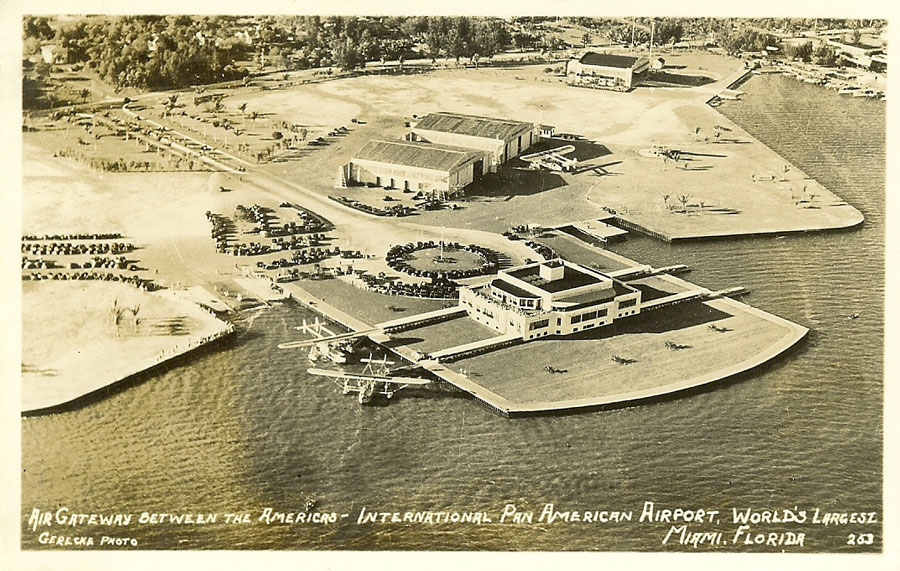
The Pan American Seaplane Terminal at Dinner Key
by Beth Dunlop
Miami Herald
Oct. 31, 1982
When it opened in 1933, Pan American World Airway's Clipper Terminal on Dinner Key was hailed as the world's most progressive marine air terminal. As the Clipper planes set forth for Cuba and Caracas and points throughout the Caribbean and South America, Miami began to earn the appellation, Gateway of the Americas.
Pan Am's first terminal at Dinner Key was a houseboat, and the seaplanes were stored in a hangar, erected in 1931. Two years later, the airline erected its modern marine terminal, a two-story art deco structure flanked by one-story wings. The design provoked national interest, and there were articles in both architectural and aviation journals singing its praises.
Inside, there was a two-story waiting room, with a 10-foot globe in the center. The beamed ceiling was decorated with signs of the zodiac, and the walls with murals of the history of aviation. Above the curved ticket counter hung a monumental winged clock.
Upstairs, there was a dining room for 100 with an open deck that allowed for an additional 50 diners. There were two observation decks, as well as all the requisite mail and baggage, customs and public health facilities.
The Clipper Terminal was designed by the prominent New York firm of Delano & Aldrich, architects of such important revival- styled buildings as the Colony Club (Georgian), the Knickerbocker Club (also Georgian), the Willard-Straight House (Federal, now the International Center of Photography) and the Union Club (mansard-roofed, 18th-Century English).
In the early 20th Century, Delano & Aldrich had assumed the society-club architect mantle of McKim, Mead & White, and the Beaux-Arts-trained architects flourished in that role. But in the '30s, they began to design more streamlined buildings, including the Pan Am Clipper Terminal and LaGuardia Airport's first passenger and marine terminals, built in 1939 in conjunction with the New York World's Fair. In 1952, William Adams Delano won the American Institute of Architects' Gold Medal, its most prestigious honor.
In its heyday, the Clipper terminal served 50,000 passengers annually, but more importantly, it drew an average of 30,000 visitors a month, and in the tourist season, that number rose to 100,000 a month. During World War II, Dinner Key became a Navy base, and in 1943, President Franklin Roosevelt boarded a clipper ship headed for Casablanca there -- the first time a president traveled in an airplane.
After the war, the city of Miami bought Dinner Key for use as a park, and in 1950, converted the Clipper Terminal into a restaurant and marina office. Four years later, it was converted once again --into Miami's City Hall.

 |
| Miami Daily News, April 18, 1934 |
 |
| Miami Daily News, Feb. 24, 1934 |
 |
| Miami Daily News, May 27, 1934 Click image to enlarge |
 |
| Click photographs to enlarge. |
 |
| Miami Daily News, March 27, 1935 |
 |
| Miami Daily News, April 14, 1935 |
 |
| Miami Daily News, April 18, 1935 |


 |
| Miami Daily News, Oct. 28, 1935 |
 |
| Miami Daily News, Nov. 18, 1935 |




 |
| Palm Beach Post, Jan. 20, 1946 |
 |
| Miami Daily News, Oct. 4, 1950 |


